The Bull Run starts here

Master's Degree in Financial Markets

Financial Markets Expert Certification

550 h

Updated on 25/05/2026

The financial markets sector is experiencing significant growth, linked in part to the computerization and financialization of the economy. The speed at which a substantial amount of information circulates related to market activities is driving professionals in the field to implement complex processing methods for data collection, analysis, and decision support. It also necessitates the design of increasingly complex financial products to optimize returns, products which must be marketed effectively.

The Financial Markets Expert program prepares students to understand the demanding world of financial markets. It is structured around three fundamental areas: valuation methods, risk management, and the computer-based application of quantitative methods. Furthermore, the program incorporates technological innovation (blockchain, big data, crypto-assets) and the rapid growth of fintech.

This MBA allows you to obtain the Financial Markets Expert Certification level 7 (RNCP38601).

Training duration

550 hours 

Personalized appointment

Training Formats

THE KEY STRENGTHS OF THE TRAINING

Master's Degree in Financial Markets

VALIDATE THE 5 BLOCKS in Market Finance
Are you looking to become an independent trader?

This Master's degree will allow you to develop
all the necessary skills
to successfully integrate yourself as a trader

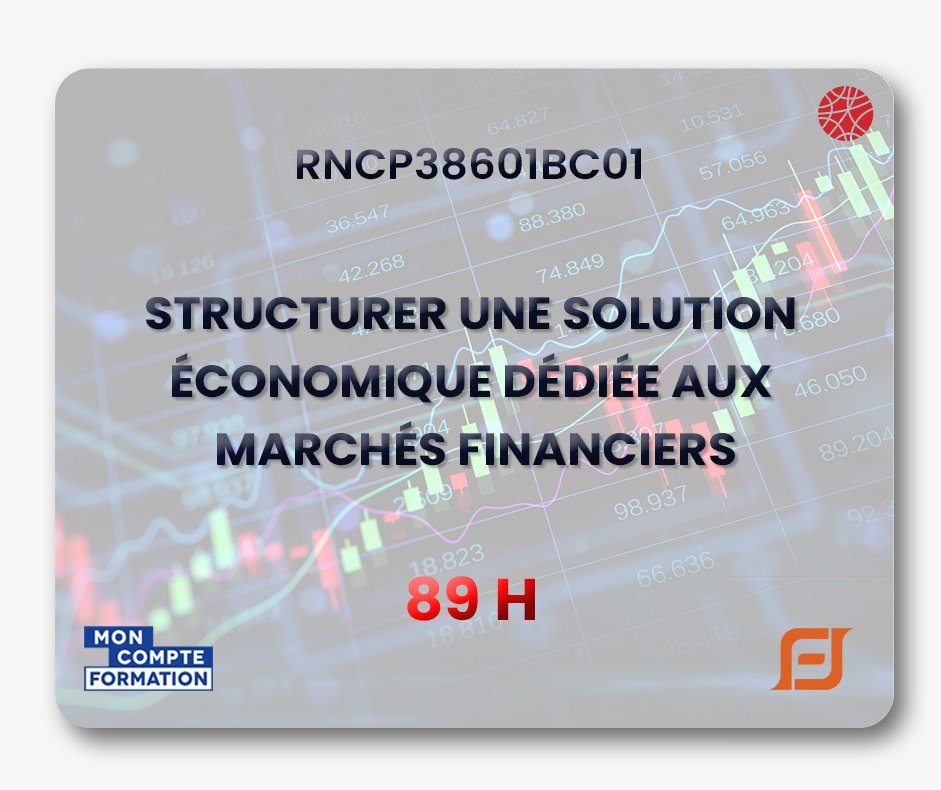
Block 1
RNCP38601BC01

Structuring an economic solution dedicated to financial markets
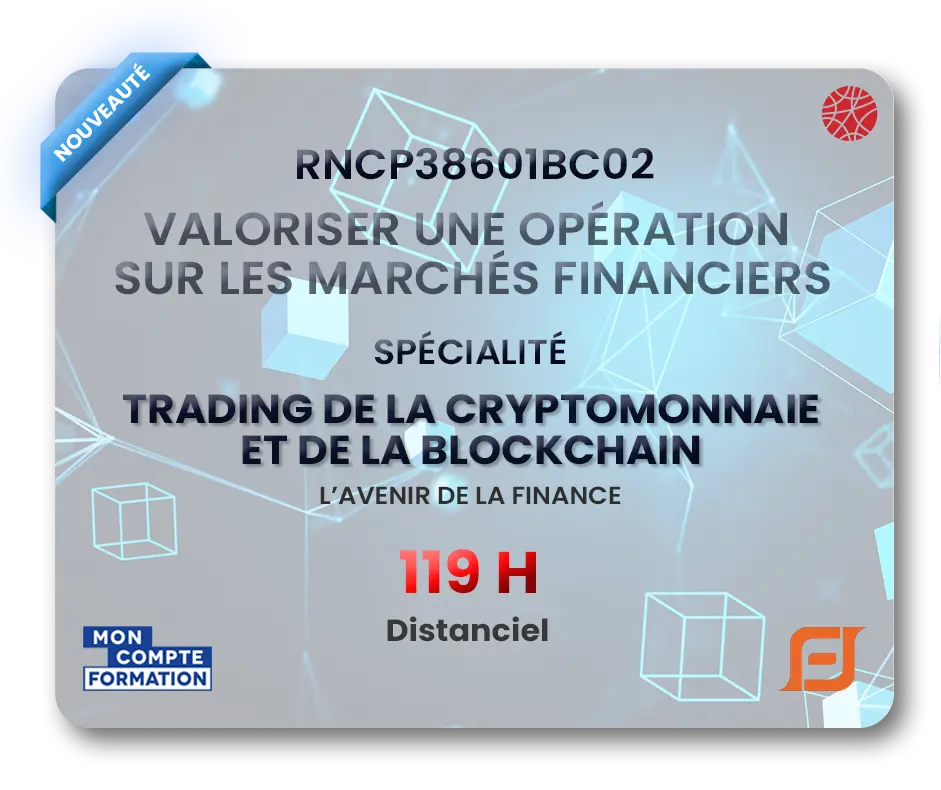
Block 2
RNCP38601BC02

To quantitatively value a transaction on the financial markets

Specialty: Cryptocurrency and Blockchain
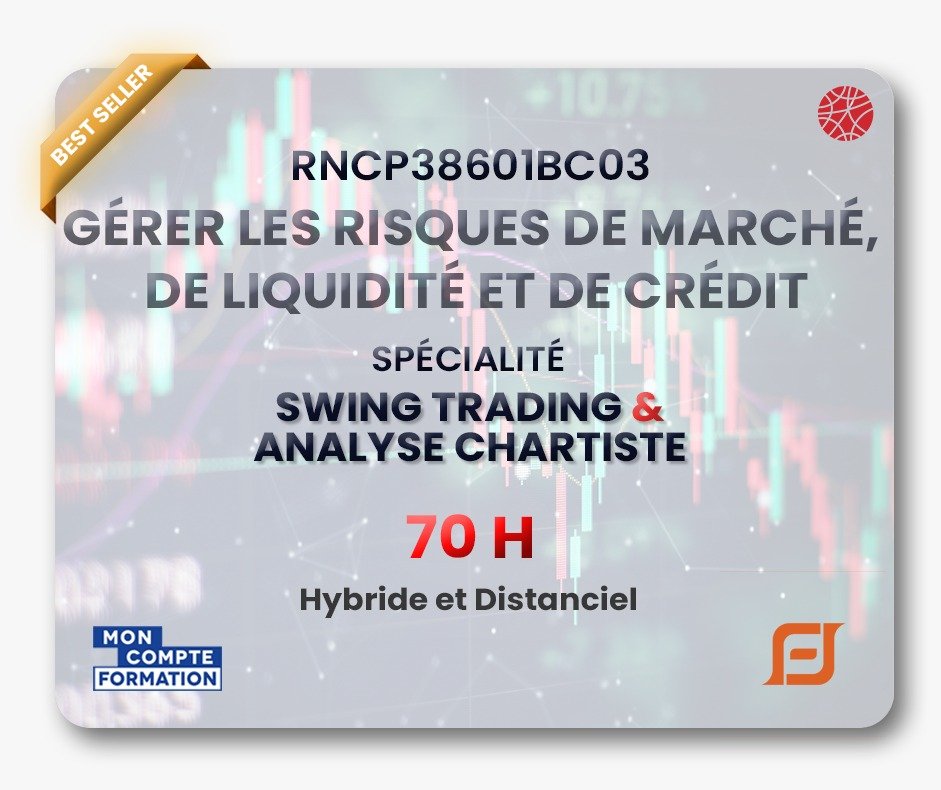
Block 3
RNCP38601BC03

Managing market, liquidity and credit risks

Specialty: Swing Trading and Chart Analysis
Block 4
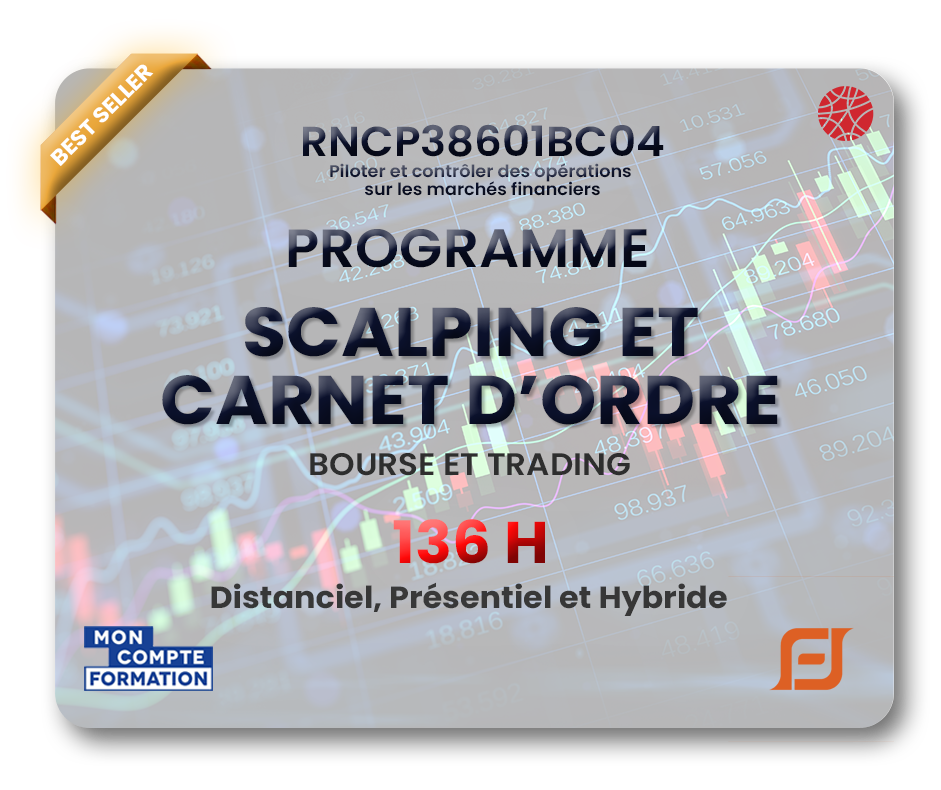
RNCP38601BC04

Managing and controlling operations on financial markets

Specialty: Trading and Scalping
Option
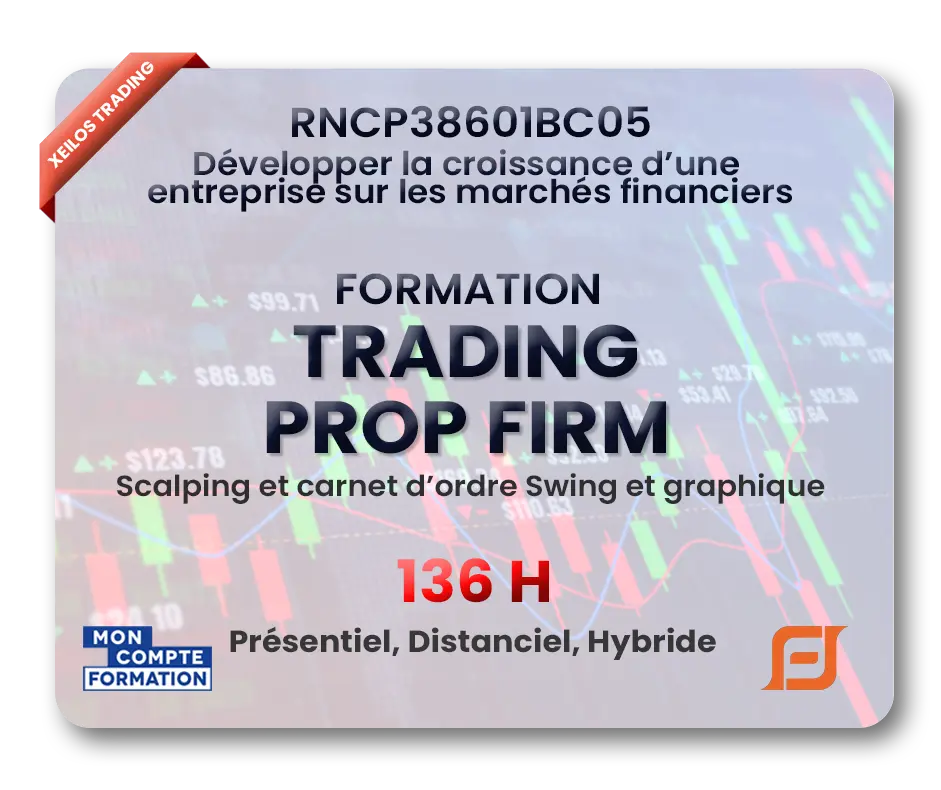
RNCP38601BC05

Developing a company's growth in the financial markets

Specializing in trading with prop firms

TRAINING OBJECTIVES

1. TRADING AND SCALPING
  • Financial diagnosis, strategic analysis, needs assessment.
  • Macro-financial analysis, asset selection,
  • Financial structuring, portfolio engineering, regulatory integration.
  • Rapid execution, mastery of the order book, emotional discipline.
2. Cryptography and Blockchain
  • Solid foundations in valuation, adaptation to asset classes.
  • Proficiency in quantitative tools, ability to analyze complex scenarios.
  • Programming applied to finance, automation, advanced simulation.
  • Crypto analysis, adaptation of traditional models to digital assets.
MANAGING MARKET, LIQUIDITY AND CREDIT RISKS
  • Cross-functional financial literacy, comprehensive understanding of financial risks.
  • Mastery of quantitative tools applied to the market, rigorous assessment of extreme risk.
  • Ability to anticipate liquidity pressures, implementation of preventive measures.
  • Counterparty risk, credit model design.
4. Risk Management
  • A comprehensive and structured view of financial operations.
  • Mastery of regulations and securing of operations.
  • Real-time operational management, consistency check.
  • Anticipation, management and reduction of operational risks.
5. PRop Firm
  • Knowledge of financing mechanisms, strategic vision.
  • Finance applied to business growth.
  • Expertise in valuation, understanding of investor expectations.
  • In-depth understanding of the prop firm model, ability to make critical comparisons.

TRAINING ELEMENTS

Block 1
RNCP38601BC01

Structuring an economic solution dedicated to financial markets
  • Sale of financial products: Opportunity plan design
  • Portfolio management: Structuring investment solutions for project contracting
  • Bond management Origination of debt in financial markets
  • Market finance : Management of financial portfolios with securities invested in stocks and bonds

Block 3
RNCP38601BC03

Managing market, liquidity and credit risks
  • Design of market risk measurement models: Market risk management
  • Liquidity risk management: Asset Liquidity
  • Management
  • Credit risk management through debt: Debt and credit risk
  • Designing default probabilities using econometric measurements: Probability and Statistics, Econometrics (Levels 1 & 2), Scoring

Financial Markets Expert Certification is specifically designed to offer detailed trading training to those who wish to distinguish themselves in the financial sector through practical knowledge.

Block 2
RNCP38601BC02

To quantitatively value a transaction on the financial markets
  • Numerical application using Excel-VBA: Calculating the transaction price for financial products on organized markets
  • Introduction to programming (Python): Codification in computer language of theoretical valuation models of financial products.
  • Evaluation of options using VBA: Drafting methodological notes for valuation models

Block 4
RNCP38601BC04

Managing and controlling operations on financial markets
  • Risk mitigation management through the issuance of collateralized financial products: Management of secured financing
  • Reconciliation of a financial market transaction after the transaction: Compliance (Know Your Customer & Anti-Money Laundering and Counter-Terrorist Financing)
  • Bringing a financial market transaction into compliance: Middle & Back office management, Compliance (Customer Knowledge)
  • Managing commercial activity using advanced reporting: Performance indicators

Option
RNCP38601BC05

Developing a company's growth in the financial markets
  • Defining financing options on financial markets: Introduction to financial markets
  • Identification of refinancing methods on financial markets for the bank: Banking strategy
  • Issuance of a capital product on the financial markets: Investment Banking
  • ESG extra-financial analysis of companies: Financial instruments: SRI asset management
The Traders' School

recognized training by the State

The Certificationn d'’ Financial Markets Expert allows you’obtaining a state-recognized diploma, registered at National Directory of Professional Certifications (*) and France compétences. RNCP38601

(*) The Financial Markets Expert title, NFS code 313, professional certification level 7 registered with the RNCP, decision of the 09/02/2024.

THE TRADERS' SCHOOL

THE STRENGTHS OF XEILOS TRADING

Xeilos Trading Its aim is to democratize access to finance professions, which are often considered luxury careers. We firmly believe that everyone has the potential to earn a good living through trading and that the field of finance is accessible to all.

Join us to discover that it's possible!

The Success of Our Former Students

“In addition to the 10k in profits, I acquired know-how and technical skills…”

FRANK LIOTARD

The essentials of the Stock Market & Trading Program

Lorem ipsum dolor sit amet, at mei dolore tritani repudiandae. In his nemore temporibus consequuntur, vim ad prima vivendum consetetur. Empty feugiat at pro, mea aperiam

The Program

Financial Portfolio Management

Stock Market & Trading Specialist

General course

1. Financial and economic study

  • Training & Sources : Understand the economic basics, the cycles, and identify reliable sources of information.
  • Data Collection & Analysis : Monitor economic indicators, analyze trends qualitatively and quantitatively.
  • Interpretation & Strategy : To project future economic phases, understand their impact on investments, develop a strategy and assess the risks.
  • Report & Reassessment Document and present the results, and adjust the strategy.

2. Asset Allocation Strategy

  • Foundations & Analysis : Understanding the economy, sectors, relevant indicators, and analytical tools.
  • Forecasting & Communication : Use predictive models, anticipate risks, and communicate results for strategic adjustment.

3. Investment Identification

  • Fundamentals & Techniques : Use fundamental, technical, and chart analysis to evaluate potential investments.
  • EES criteria : Integrate ethical, environmental and social criteria into the investment strategy.

4. Bond Selection

  • Foundations & Analysis : Understand the characteristics of bonds and risks, evaluate issuers and identify opportunities.
  • Portfolio & Tracking Diversify, create a strategy, and rebalance according to market conditions.

5. Portfolio optimization

  • Risk Analysis & Management : Study the indices, analyze the listed values, and establish a timing strategy.
  • Monitoring & Improvement : Monitor performance, evaluate investments, and continuously adjust the strategy.

6. Business Development

  • Foundations & Consulting : Follow ethical principles, assess risk profiles, and learn to communicate effectively.
  • Conclusion & Follow-up Formalize transactions, plan regular updates, and participate in ongoing training.
The Objectives

This Master's program allows you to acquire all the skills related to the certification of Expert in Market Finance:

  • Strategic monitoring: Analyzing trends and developments in the financial market using monitoring and analysis tools.
  • Financial market analysis: Evaluating investment risks and opportunities at the national and international level.
  • Data collection and analysis: Implementing programs and tools to collect and analyze financial data.
  • Financial forecasting: Establish forecasting models based on statistical and econometric analyses.
  • Valuation of financial instruments: Evaluate the value of derivative products and financial instruments.
  • Structuring financial products: Designing products tailored to investors using various financial instruments.
  • Macroeconomic analysis: Identify current and future economic phases to optimize investments.
  • Asset selection: Choosing stocks and bonds based on fundamental, technical and market analyses.
  • Market monitoring: Monitoring the evolution of stock market and economic values to make opportune investments.
  • Investment advice: Offering investment solutions tailored to clients' risk profiles.
  • Risk management: Assessing, mapping and managing economic, operational, financial and legal risks.
  • Reporting and activity management: Implement reporting and activity management systems to ensure monitoring and performance.
  • Team management: Managing a team using collaborative tools and promoting skills development.
Prerequisites

Candidates for training leading to a skills block are subject to a preliminary interview and to the presentation of a portfolio demonstrating their ability to follow and validate the professional certification:
This file will include a summary presentation sheet of the intern and their professional project And Being holder of a level 4 certification (Baccalaureate) to 6 (Bac+3) in the field targeted by the skills block or a related field, and provide proof of professional experience of 12 to 48 months minimum depending on their academic level.

To obtain the title, candidates can accumulate skill blocks. In order to validate the awarding of the qualification, it is imperative that the candidate demonstrates the necessary prerequisites when registering for the last skills block, allowing them to present themselves to the certification jury for the full qualification.

Specific exemptions:
If the candidate does not have the required professional experience or diploma, the candidate must submit a file demonstrating their ability to validate the professional certification (VAP, employer certificate or other evidence of professional, personal or associative experience enabling the acquisition of related skills…).

TRAINING SUMMARY

Overview of the content and key points

Master's Degree in Financial Markets

program summary

1. Structure an economical solution dedicated to financial markets

  • Part 1: Analysis of the client portfolio and risk profile
  • Part 2: Analysis and Allocation of Key Investor Data (KIID)
  • Part 3: Bond Issuance & Financial Analysis
  • Part 4: Financial Markets

2. To quantitatively value a transaction on the financial markets 

  • Part 1: Managing Operator Activities 
  • Part 2: Supervision of Operator Operations
  • Part 3: Development of a financial prediction algorithm

3. Manage market, liquidity and credit risks

  • Part 1: Market risk management using Value at Risk (VaR)
  • Part 2: Valuation of financial instruments and their data
  • Part 3: Market Risk Assessment Strategies to Identify, Measure and
    mitigate financial risks
  • Part 4: Definition of Financial Risk Management Standards
  • Part 5: Monitoring and Controlling Trading Floor Operations: Oversight
    Real-Time and Regulatory Compliance

4. Manage and control operations on financial markets

  • Part 1: Economic, legal and social monitoring of the sector
  • Part 2: Analyzing the Dynamics of Financial Markets
  • Part 3: Developing a Structured Product for a Potential Investor
  • Part 4: Banking Compliance, KYC, UBO and AML/CFT

5. Developing a company's growth in the financial markets

  • Part 1: Study of current and future economic trends
  • Part 2: Implementing an Effective Asset Allocation Strategy
  • Part 3: Identifying Investment Potential
  • Part 4: Bond Selection for Profitability Optimization
  • Part 5: Business Development and Risk Profiling

Would you like to discover the program in more detail?

The program's objectives

This Master's program allows you to acquire all the skills related to the Financial Markets Expert certification.

  • Block 1: Structuring an economic solution dedicated to financial markets
    • Understand and analyze investor needs (objectives, time horizon, risk profile).
    • Identify short- and long-term investment opportunities in the financial markets.
    • Select and structure suitable solutions (shares, bonds, derivatives, structured products).
    • Design balanced portfolios that integrate profitability, diversification and regulatory compliance.
    • Mastering the reading and interpretation of the order book.
    • Develop effective scalping strategies based on market microstructure.
    • Put trading techniques into practice on simulators and in a virtual trading room.
    • Managing profitability and risks through valuation tools and strict money management rules.
    • Present and justify an opportunity plan to investors or decision-makers.
    • Produce financial and extra-financial reports integrating ESG impact and performance achieved.
  • Block 2: Quantitatively valuing a transaction on the financial markets 
    • Mastering classic financial valuation methods (Discounted Cash Flow, comparative models, market multiples).
    • Apply advanced pricing models (Black-Scholes, binomial, Monte Carlo, stochastic models) to value stocks, bonds and derivatives.
    • Develop expertise in quantitative analysis: volatility, correlations, beta, sensitivities («greeks»).
    • Use computer tools and programming languages (Python, R, VBA) to automate calculations and build financial models.
    • To enhance the value of mixed portfolios including traditional and digital assets (cryptocurrencies, tokens, stablecoins).
    • Understanding and integrating blockchain innovations (smart contracts, DeFi, asset tokenization) into valuation models.
    • Identify and manage the specific risks of cryptocurrencies: extreme volatility, limited liquidity, regulatory uncertainty.
    • Present the results in a clear and usable manner, through methodological notes and oral presentations tailored to financial decision-makers.
  • Block 3: Managing market, liquidity, and credit risks
    • Identify and understand the different types of financial risks: market, liquidity and credit.
    • Apply advanced risk measurement methods (VaR, Expected Shortfall, stress tests).
    • Assessing the liquidity of a portfolio and anticipating financial tensions.
    • Build and use scoring and default probability models to measure credit risk.
    • Deploy effective hedging strategies (options, futures, swaps, CDS).
    • Leveraging technological and data science tools (Python, R, big data, machine learning) to refine risk analysis.
    • Implement an integrated risk mapping and a monitoring system that complies with regulatory standards (Basel III, Solvency II, IFRS 9).
    • Develop the ability to communicate and simplify complex analyses to senior management, regulators and investors.
    • Contribute to the definition and management of a company's Risk Appetite Framework.
  • Block 4: Managing and controlling operations on financial markets
    • Understanding the complete financial operations cycle and the front-to-back chain.
    • Mastering compliance procedures (KYC, AML/CFT, MiFID II, GDPR).
    • Ensure rigorous monitoring and control of market transactions.
    • Detect and manage operational risks related to settlement errors or incidents.
    • Develop effective swing trading strategies based on multi-timeframe technical analysis.
    • Managing positions over several days/weeks with discipline and risk management.
    • Produce reliable consolidated reports for management and stakeholders.
    • Improve communication and coordination between teams (front, middle, back office).
    • To acquire a managerial posture capable of steering and supervising financial operations with rigor and efficiency.
  • Block 5: Developing a company's growth in the financial markets
    • Understanding how to use financial markets as a lever for financing and growth.
    • Develop financing plans tailored to the strategic needs of businesses.
    • Mastering valuation methods before a fundraising round or an IPO.
    • Discover and analyze the functioning of prop firms and their conditions of access.
    • Develop trading strategies tailored to the specific constraints of prop firms.
    • To prepare concretely for the evaluation phases of prop firms via
    • simulations.
    • Studying cases of companies that have exploited markets to grow or reinvent themselves.
    • Develop a dual skill set: expertise in market financing and discipline in financed trading.

Do you have specific goals to achieve? Let's meet and find the training that suits you.

Prerequisites

Access to the Master's program in Financial Markets is open to a motivated public, eager to develop in-depth expertise in market finance.

To enroll in this level 7 program (RNCP 38601), it is recommended to be:

  • Holder of a level 6 or 7 certification (Bachelor's or Master's degree) in the
    fields of economics, finance, management, law, and
    mathematics, engineering or business.
  • Professional in career transition or already active in a banking, financial or investment environment, wishing to enhance their skills.

Some prior knowledge is expected to fully benefit from the program:

  • Solid foundation in financial and economic analysis.
  • Proficiency in quantitative tools and mathematical calculations (probabilities,
    statistics, stochastic calculations).
  • General knowledge of market operations and financial products
    (stocks, bonds, derivatives, digital assets).
  • Prior experience or knowledge of computer languages applied to finance (VBA, Python, R) is a significant asset.

This Master's program is also aimed at trading enthusiasts who wish to move towards a professional career in market finance, with an opening towards innovative specializations (scalping, swing trading, crypto/blockchain, prop firms).

Do you want to know if you have the necessary prerequisites to join this program?

Ready to become a finance professional?